


Graphics

Artistic impression of a planetary system around a slightly hotter star than our Sun. Carl Sagan Institute scientists have theorized that organisms could evolve biofluorescence to protect themselves from a more intense star.
Credit: Gillis Lowry

Artistic impression of a planetary nebula nestled within an open star cluster, located millions of light years away (the Andromeda Galaxy). Nebulae like these are the result of dying stars, but the production of planetary nebulae from stars with more mass than the Sun is not well understood. A 2026 paper (Chen et al., ApJL) studied the open cluster surrounding this nebula to determine the mass of the progenitor star. Credit: Gillis Lowry

Diagram depicting habitable zone boundaries across star type with rocky exoplanets from my research (Bohl et al. (2026)). The boundaries of the habitable zone shift based on star color, since different wavelengths of light will heat a planet's atmosphere differently. Credit: Gillis Lowry / Pablo Carlos Budassi

Three artistic renderings of the same planet as it transitions from a hot Earth-like world to a barren exo-Venus. Credit: Gillis Lowry
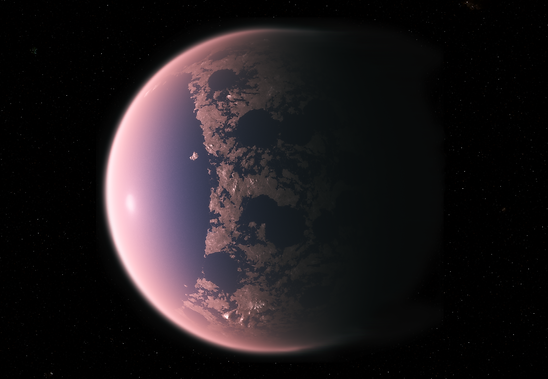
Artistic impression of LHS 1140 b, a tidally locked exoplanet with a radius around 1.7 times bigger than Earth. In July 2026, astronomers detected evidence for an escaping helium atmosphere, shown here as a faint trail on the top and bottom edge of the planet. Credit: Gillis Lowry

An artist's impression of a theoretical planet orbiting a redder star, which could cause microbes and plants on the planet's surface to reflect very different colors from Earth’s green forests. Credit: Gillis Lowry

Artistic impression of a lava world: a rocky planet that has either recently formed or orbits too close to its star to cool down. Credit: Gillis Lowry

In-progress public-audience visualization of exoplanets across the night sky. Users can toggle habitable zone planets in green or search for them among a sea of stars. Clicking on a planetary system brings up text and graphics depicting the sizes of stars planets in the system, orbit animations, and more. Credit: Gillis Lowry